01 // Follow the names
The disaster changes. The financial machinery repeats.
These institutions do not appear in every deal, and nothing here says they caused the disasters. They appear because catastrophe creates a second problem after the physical emergency: somebody has to finance the extraordinary cost.
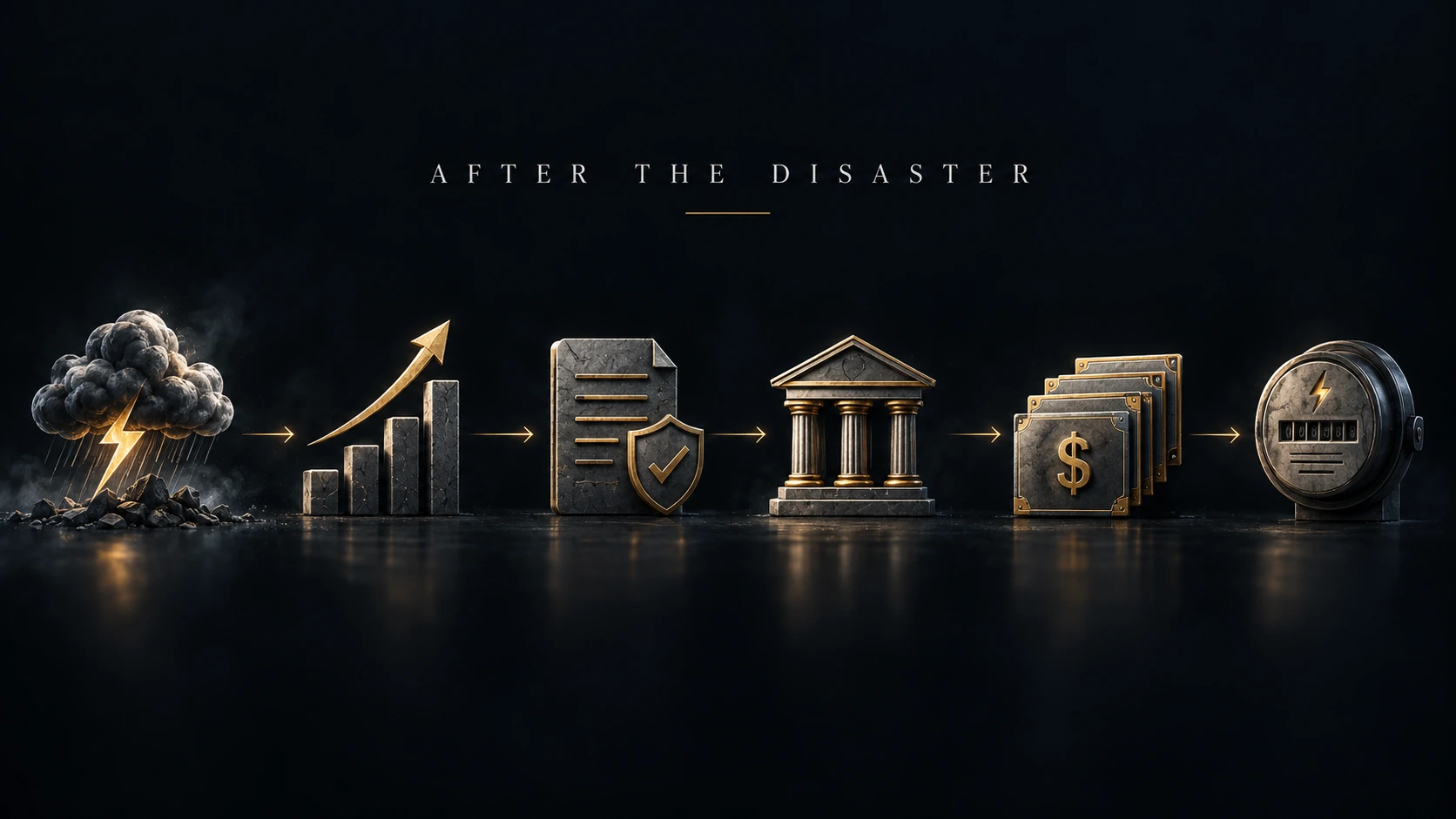
A disaster creates costs. Law creates a recovery right. Finance turns that right into an asset.
The utility has a huge approved cost today. The state allows recovery over time. That future collection right becomes property. A separate entity holds it. Investors provide cash now by buying bonds. Customers repay the structure over years.
02 // California precedent
The rail existed before the 2021 Texas freeze.
California built crisis-finance infrastructure during the 2000–2001 energy crisis. Years later, AB 1054 ended the old DWR bond charge and created a Wildfire Non-Bypassable Charge collected in the same manner.
DWR says the wildfire program collects $902.4 million annually from customers of the state’s three largest investor-owned utilities through January 1, 2036, and authorizes up to $10.5 billion in bonds for the California Wildfire Fund.
$7.5 billion in two transactions.
PG&E Wildfire Recovery Funding LLC issued $3.6 billion in May 2022 and another $3.9 billion in July. Citigroup, Goldman Sachs, J.P. Morgan, Barclays and others appear in the underwriting stack; BNY Mellon Trust served as trustee.
What to see: the disaster is temporary. The collection infrastructure can persist.
03 // Texas // February 2021
Then Texas froze.
Winter Storm Uri — the catastrophic February 2021 Texas freeze — brought power failures, gas shortages, disrupted water systems, and extraordinary wholesale gas prices.
By March 2023, the Texas Natural Gas Securitization Finance Corporation had issued $3.52175 billion of Customer Rate Relief Bonds to finance approved extraordinary natural-gas costs from the storm.
The unusual part was not simply that Texas borrowed money. It was what backed the borrowing: a future stream of customer charges.
The charge created an entire professional layer.
Jefferies was book-running senior manager. Morgan Stanley, Barclays and other firms appeared as underwriters. Norton Rose Fulbright, McCall Parkhurst, Locke Lord and Orrick handled legal roles. U.S. Bank Trust served as indenture trustee.
The official statement reports an underwriters’ discount of about $13.52 million.
Future customer payments became present-day cash.
Atmos reported about $2.02 billion in proceeds, CenterPoint and its gas utility about $1.1 billion, and ONE Gas about $197 million for Texas Gas Service.
Keep the categories straight: these are utility-level proceeds, not personal payouts to executives.
04 // Now watch it repeat
Different disasters. Same financial grammar.
Once you know the pattern, it becomes hard to unsee: approved cost → recovery property → special-purpose issuer → bonds → customer charge.
More restoration bonds. Familiar institutions.
CenterPoint’s 2025 restoration-bond deal totaled $401.521 million, with Citigroup and Barclays as underwriting representatives and U.S. Bank Trust as trustee. In 2026, another $1.193474 billion deal brought in Citigroup, J.P. Morgan, Morgan Stanley, BofA Securities, and U.S. Bank Trust.
The structure is not uniquely Texan.
Duke Energy says it completed about $1 billion in North Carolina storm-recovery bond financing. A Louisiana SWEPCO financing order covering hurricanes and winter storms uses an SPE, storm-recovery property, true-up provisions, and charges described as irrevocable, binding, and nonbypassable.
05 // Follow the institutions
Now the recurring names make sense.
This does not show that banks caused the disasters. It shows which institutions repeatedly occupy the specialized finance rail once a securitization reaches the market.
| Institution | PG&E wildfire | Texas Uri | TX restoration 2025 | TX restoration 2026 | Role seen |
|---|---|---|---|---|---|
| Citigroup | ✓ | — | ✓ | ✓ | Bookrunner / underwriter |
| J.P. Morgan | ✓ | — | — | ✓ | Bookrunner / underwriter |
| Morgan Stanley | — | ✓ | — | ✓ | Underwriter / bookrunner |
| Barclays | ✓ | ✓ | ✓ | — | Underwriter / bookrunner |
| U.S. Bank Trust | — | ✓ | ✓ | ✓ | Indenture trustee |
| BNY Mellon Trust | ✓ | — | — | — | Trustee |
06 // What this means
The trick is learning what counts as an asset.
Most people look at a utility bill and see a bill. Structured finance can look at a legally enforceable stream of future payments and see financeable property.
Securitization can lower financing costs and spread extraordinary expenses over time. Nothing here proves wrongdoing.
The crisis is temporary. The legal right to collect can outlive it.
07 // Method
Follow the structure, not the suspicion.
The Archive separates documented fact, structural recurrence, economic consequence, and inference. A recurring bank does not prove control of a disaster. A customer-backed bond does not by itself prove customers received a bad deal.
08 // Receipts
Open the source layer.
This is a living dossier. The source layer remains attached so the structure can be checked, corrected, and expanded as new financing orders, bond offerings, and catastrophe-recovery programs appear.