01 // Baseline
Start with the number.
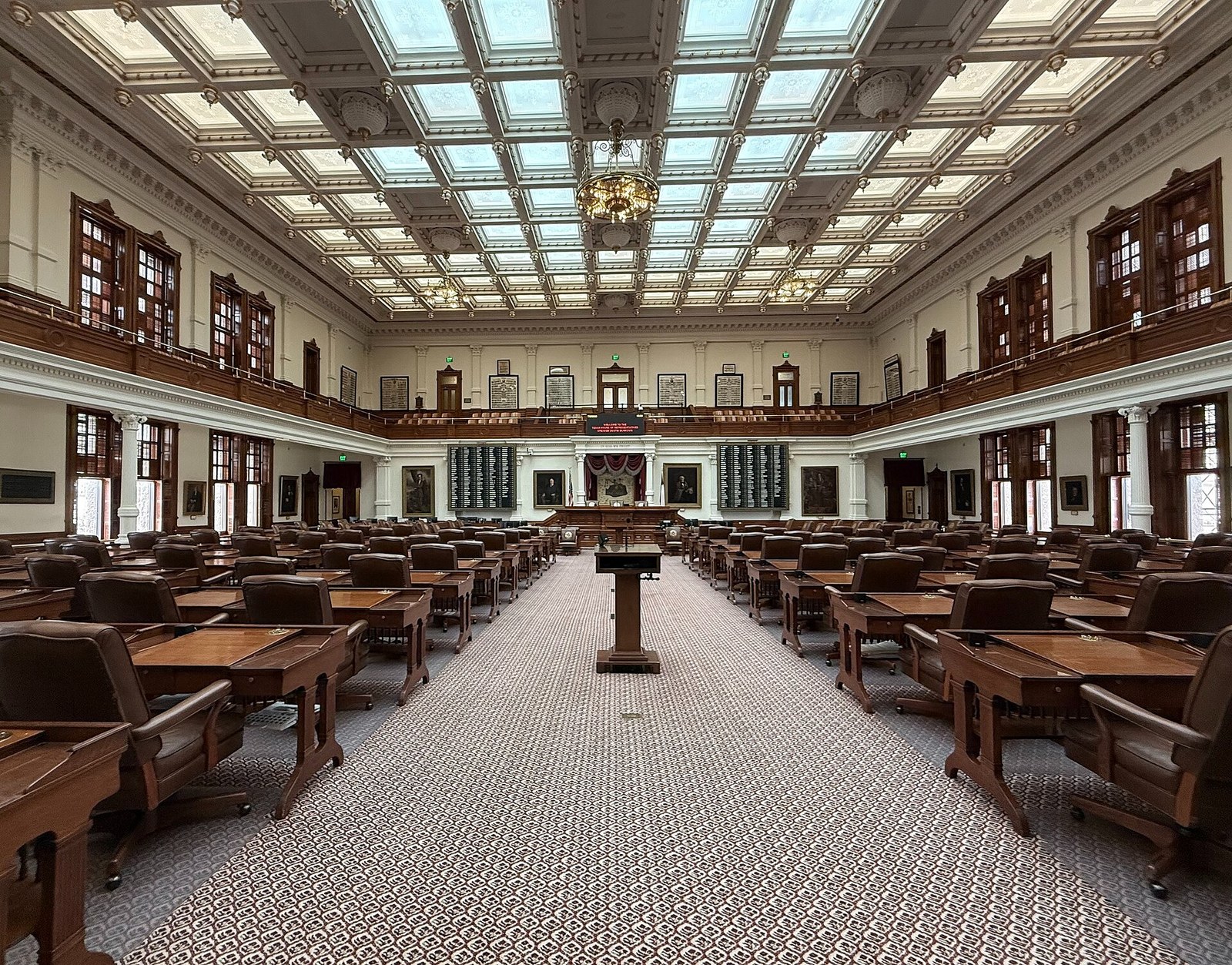
The Texas House has 150 seats. The Speaker is elected by House members, not by a statewide vote. In a full chamber, the governing number is 76.
In January 2025, Dustin Burrows won the gavel 85–55 over David Cook. That vote gives us the starting board for understanding the next Speaker fight.
The 2025 vote is the starting map. It is not the 2027 map.
The temptation is to take Cook’s 55 votes, imagine them transferring intact to a new anti-Burrows candidate, and then ask where the remaining 21 come from. But that assumes the old coalition survives unchanged.
It does not.
02 // Turnover
The board is already changing.
By June 2026, the Legislative Reference Library was already tracking 25 House members who would not return to the 90th Legislature in their current House seats. Sixteen of those departing members are Republicans.
When those 16 Republicans are matched back to the final 2025 Speaker vote, nine Cook votes and seven Burrows votes disappear from the old board.
David Cook himself is among the members leaving the House. So the anti-Burrows coalition does not merely need a new candidate. It has to be rebuilt around a changing membership.
The freshman / replacement bloc matters.
A new member entering January 2027 has no personal Speaker vote from 2025 to defend. That does not make the member automatically pro-Harrison, anti-Burrows, or part of any other faction.
Why it matters: the most important swing bloc may be members who were not in the old fight at all.
03 // Power structure
The House has more than two sides.
The visible fight is easy to understand as two camps: Burrows on one side, and a more insurgent or movement-conservative bloc on the other.
The underlying structure is messier.
House leadership, primary pressure, business-backed legal reform, plaintiffs’ lawyers, executive endorsements, committee positions, and local electoral pressures can all overlap on the same member. A useful map therefore has to track relationships and pressure lanes without pretending those relationships prove a future Speaker vote.
Armin Mizani vs. Fred Tate
HD98 became a useful example of why the 76 map cannot be reduced to simple personality camps. TLR heavily backed Fred Tate. Mizani drew support from the opposing plaintiffs’ lawyer network, including Texans for Truth and Liberty and the Texas Trial Lawyers Association.
Mizani won the Republican primary.
Why it matters: some incoming members are arriving through a money fight that cuts across the usual “establishment vs. conservative” shorthand.
One member. Several power lanes.
Marc LaHood illustrates the overlap problem. He has operated inside the House under Burrows while also receiving support from plaintiffs’ lawyer-aligned groups and becoming part of a legislative fight against a major TLR priority.
Why it matters: the same member can sit at the intersection of multiple networks. That is why donor relationships are evidence of structure — not proof of a future Speaker vote.
04 // The next gate
November decides who gets in the room.
Before the House can choose a Speaker, voters choose the House. That sounds obvious, but it changes how the 76 map should be read.
Any district that changes hands in November can erase an old Burrows vote, erase an old Cook vote, or create a member who participated in neither coalition.
That means the 2027 Speaker race is not simply a rematch of January 2025. The membership itself is part of the contest.
November determines the room. January determines the gavel.
05 // Open questions
What would actually move the map?
How many members of the 2025 Cook bloc return — and do they remain a bloc without Cook in the House?
Which incoming Republicans arrive closest to the existing Burrows leadership structure, and which arrive outside it?
Where do TLR, plaintiffs’ lawyers, executive endorsements, and movement-conservative networks overlap on the same members?
Which November outcomes remove old Burrows votes, old Cook votes, or create entirely new coalition nodes?
Does any member publicly organize a 2027 Speaker coalition before the general election?
06 // Method
Separate the record from the inference.
The Alignment Archive treats votes, office assignments, committee roles, reported contributions, endorsements, election outcomes, and public statements as separate evidence layers.
A donor connection does not prove control. An endorsement does not prove a future Speaker vote. A committee relationship does not prove a secret agreement.
The purpose of the map is to make the structure visible while preserving the distinction between documented fact, relationship, and inference.
The Alignment Archive is not affiliated with Brian Harrison, Dustin Burrows, David Cook, or any Speaker campaign or office.
07 // Receipts
Open the source layer.
This is a living dossier. The source layer remains attached so the map can be checked, corrected, and updated as the 2026 election and 2027 Speaker race develop.