Most people read power through visible force.
Who is loud. Who has the title. Who speaks from the podium. Who controls the room visibly.
But Access Point II begins deeper than that.
Real leverage often belongs to the person, institution, company, country, or system controlling the route between a need and its fulfillment.
Leverage is not volume. Leverage is position.
Whoever controls access to what others depend on controls more than supply. They control timing, terms, permission, price, and pressure.
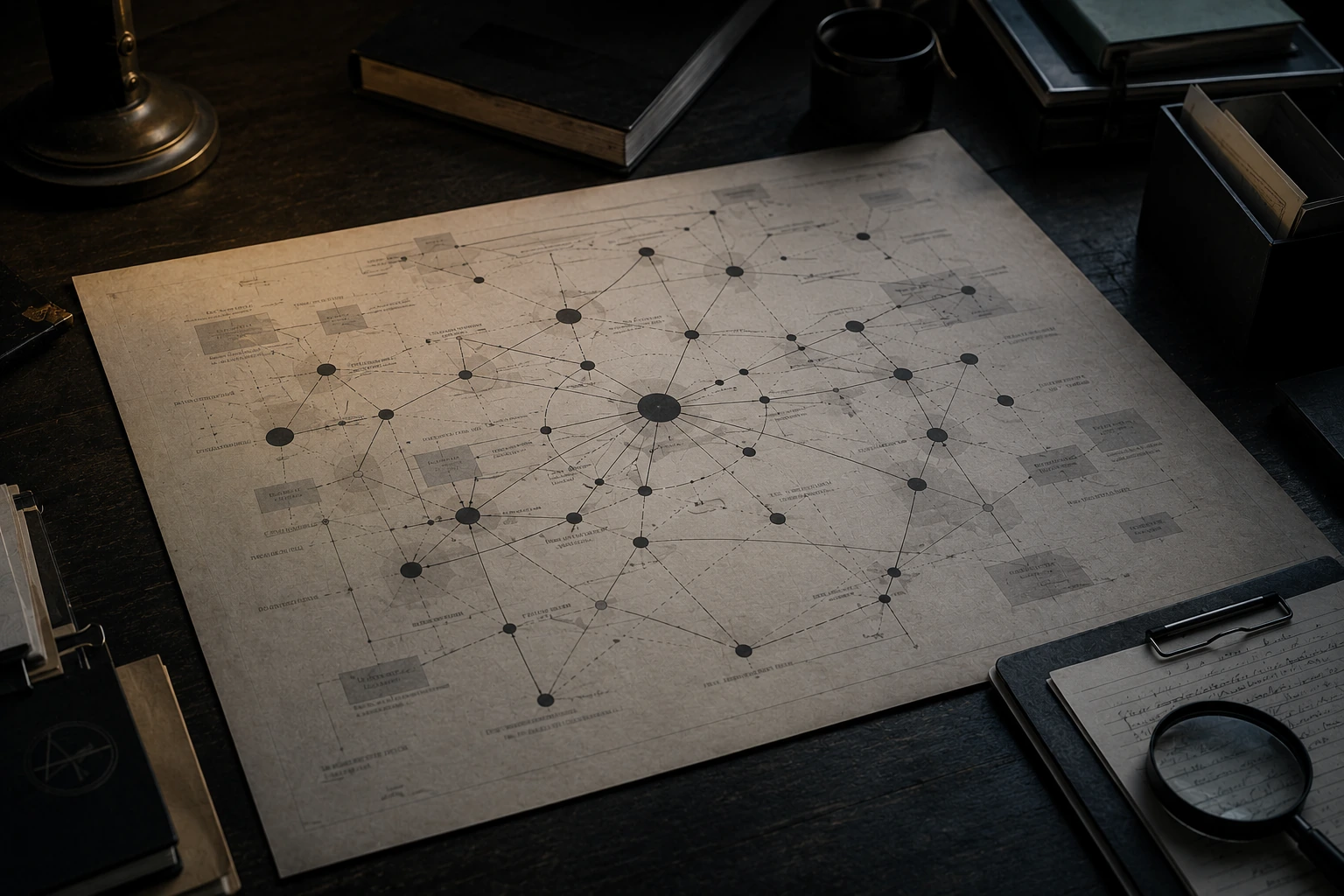
This is why power architecture cannot be read only by watching speeches, elections, headlines, or public statements.
You have to ask what the visible actor depends on.
Then you ask who controls that dependency.
The base question
Gate 01 returns to one question:
Who controls the route to what everyone else needs?
That route may be money, labor, energy, chips, land, attention, permission, language, infrastructure, medicine, data, law, distribution, search visibility, payment access, or spiritual authority.
The route changes by system.
The law does not.
The four leverage points
A leverage map begins by identifying the hidden pressure points inside any system. These four points reveal where dependence becomes control.
Dependency: What must be obtained?
Access: Who controls the gate?
Bottleneck: Where does the route narrow?
Substitution: Can the system replace the gate?
Dependency reveals what the system cannot function without: labor, capital, technology, energy, legitimacy, attention, food, data, permission, or public consent.
Access reveals who grants or blocks entry. Access becomes authority when others cannot move without passing through the gatekeeper.
The bottleneck reveals where the route narrows. Leverage increases where alternatives shrink. The chokepoint may be physical, legal, financial, technological, institutional, or narrative.
Substitution reveals whether the gate can be bypassed. If no clean substitute exists, the gatekeeper gains power. If substitutes appear, leverage weakens and the pressure map changes.
Pressure follows dependency.
When a person, company, country, institution, or population depends on something it does not control, pressure starts forming around the access point.
That pressure does not always look violent. Sometimes it looks like a rule, a delay, a fee, a requirement, a credential, a permit, a visa, a payment processor, a platform policy, a supply shortage, a moral slogan, or an expert consensus.
The form changes.
The architecture remains.
This law works at every scale.
In a conversation, leverage may form around approval, silence, access to belonging, or fear of being misunderstood.
In a workplace, leverage may form around credentials, employment sponsorship, internal reputation, promotion pathways, insurance, or managerial permission.
In a nation, leverage may form around energy imports, reserve currency access, trade routes, military protection, food supply, sanctions exposure, or critical minerals.
In technology, leverage may form around chips, cloud infrastructure, app stores, payment systems, search visibility, data access, and platform dependency.
In spiritual systems, leverage may form when people surrender direct obedience, discernment, and legal authority to counterfeit gatekeepers who demand performance before access.
The scale changes. The structure repeats. Find the dependency. Find the gate.
That is why Access Point II begins here.
You cannot read world events cleanly if you only ask who is speaking.
You have to ask who is dependent, who controls the route, who benefits from the dependency, and what alternative is being blocked.
The Leverage Map Drill
When a story becomes loud, do not start with outrage. Run the map.
01. What does this system need?
02. Who controls the route?
03. Where does access narrow?
04. Who benefits from continued dependency?
05. What substitute would break the leverage?
Look for labor, money, legitimacy, resources, votes, compliance, infrastructure, visibility, energy, data, permission, or public belief.
Find the gatekeeper. It may be a government agency, corporation, platform, bank, university, supplier, regulator, media institution, or spiritual authority structure.
Look for the chokepoint: scarcity, permits, visa sponsorship, payment rails, chip supply, ports, energy grids, search rankings, credentialing, or social approval.
Follow incentives. Someone often gains money, authority, influence, compliance, political advantage, narrative control, or market protection from the dependency remaining unresolved.
Then look for the alternative route: new suppliers, owned media, local resilience, different platforms, cash reserves, energy independence, skill depth, parallel systems, or clean spiritual authority.
The point is not fear. The point is route control.
A leverage map is not built so you can become suspicious of everything.
It is built so you stop being moved by structures you have not named.
Once the route is visible, you can decide whether to use it, avoid it, build around it, reduce dependence on it, or create your own.
That is the difference between reaction and strategy.
The strongest move is not always fighting the gate. Sometimes it is building a route the gatekeeper cannot own.
This is the practical use of a leverage map.
It gives you a way to see where pressure is forming before the pressure starts explaining itself as normal.
Once the route is visible, you are no longer only reacting to the gate. You can decide whether to pass through it, build around it, reduce dependence on it, or stop treating it as final.