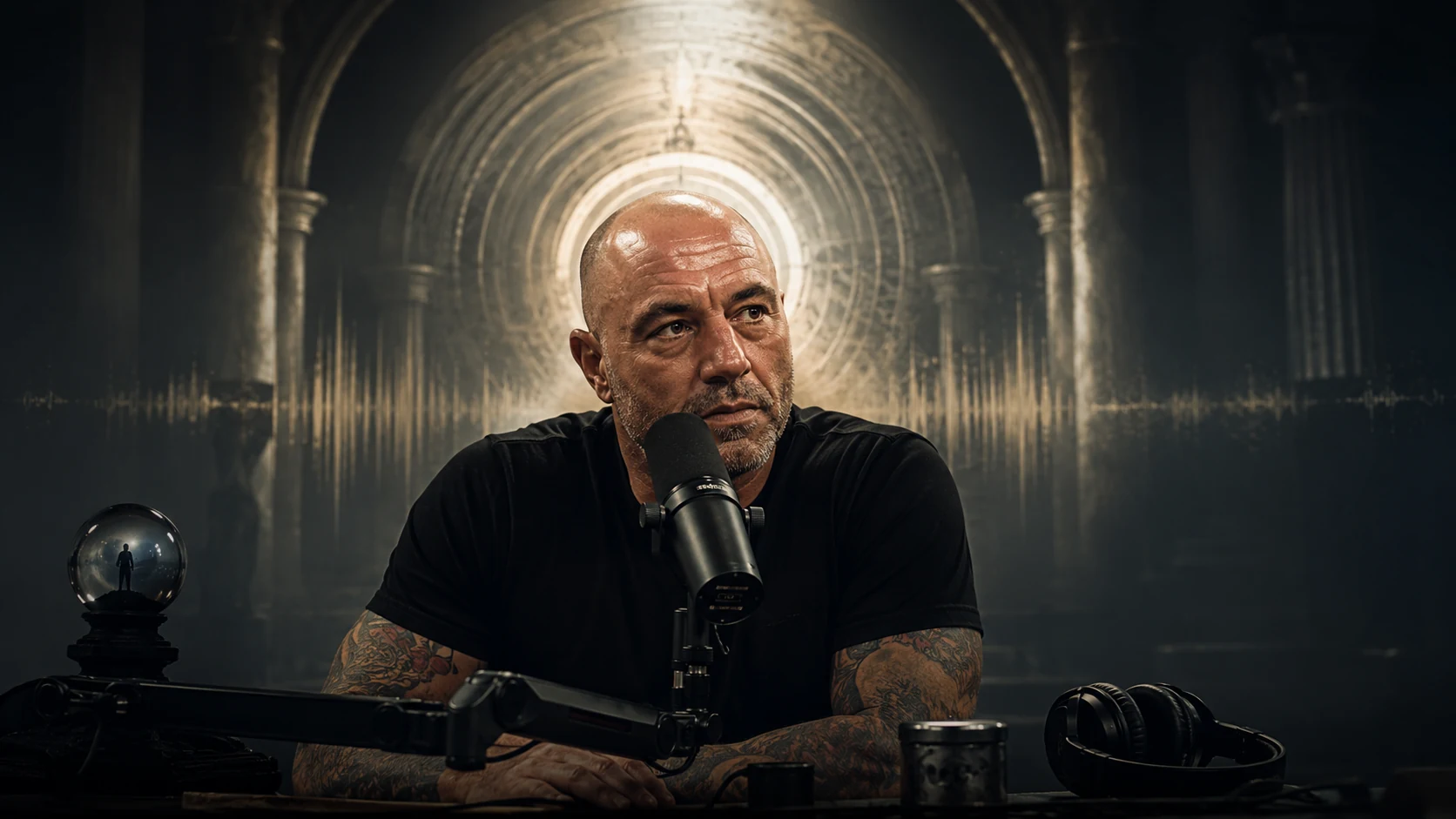
Here’s the real pattern with Joe Rogan. It is not only that he is popular, controversial, independent, curious, or willing to talk to people outside the approved lane.
Those things matter, but they are not the whole mechanism. The deeper pattern is that he became trusted because he did not sound like the institution, and then that trust became its own kind of institution.
The Outsider Authority Loop
When a person builds trust by standing outside official systems, the audience may begin treating that outsider position as proof of truth. The anti-institution posture becomes its own authority field.
That is the part worth reading carefully. A person can begin as an alternative to institutional authority and still become a center of gravity people organize around.
The original appeal is obvious. The room feels less managed. The conversation feels less scripted. There is no polished panel language, no approved institutional rhythm, no obvious gatekeeper standing at the door telling everyone what they are allowed to notice.
The power is not just that he stands outside the institution. The power is that people begin using outside as a substitute for proof.
He creates an outsider evidence field.
That is the whole draw. The conversation does not feel like a press release. It feels like someone opened a side door and let the unapproved questions sit in the room.
And when people have spent years feeling managed by official language, that side door feels like oxygen.
This is where the trust forms. Not because every conversation is correct. Not because every guest is reliable. But because the environment feels less controlled than the spaces people already distrust.
That difference creates an emotional advantage.
“At least he lets people talk.”
“At least he asks questions.”
“At least it does not feel scripted.”
“At least this is not the official narrative.”
“At least someone is willing to say it.”
Some of that is fair. Some of it is useful. Some of it is exactly why the format works.
But it also creates the opening for the loop.
Because once the audience learns to distrust the institution, they still need somewhere to place trust.
This is where the outsider becomes the institution.
Not because he suddenly becomes a government office, a university, or a newsroom. That is not the point.
He becomes an institution in the field sense: a place where attention gathers, meaning gets filtered, credibility is assigned, and people look for permission to question one thing while trusting another.
That is the Anti-Institution Institution.
The brand says, “Do not trust the official center.” But the audience can quietly build a new center around the person saying it.
And once that happens, the frame changes. The question is no longer only whether the institution is lying. The question becomes whether the alternative authority can still be examined with the same sharpness it uses on everyone else.
That is the pressure point.
The outsider position is useful until it becomes a shield against being read.
Because anti-institution energy can start as discernment and turn into identity. The audience is no longer just asking better questions. They are belonging to the group that asks better questions.
And once belonging enters, the evidence field gets complicated.
People may become more alert to the failures of official authority while becoming less alert to the authority forming inside their own alternative room.
And this is not just a podcast pattern.
You see this everywhere now. A person rejects the institution, gathers trust, builds an audience, and then becomes the place people go to decide what is real.
A media figure can do it. A wellness figure can do it. A political commentator can do it. A founder can do it. A pastor can do it. A creator can do it.
The structure is the same: opposition becomes authority.
That does not automatically make the person false. It means the authority has to be read clearly.
What is being questioned?
What is being protected?
What is allowed to be doubted?
What is treated as obvious?
Where does the outsider frame stop being a lens and start becoming a shield?
That is the clean read.
The institution is not only the building with the seal on the wall. Sometimes the institution is the room everyone trusts because it says it is not one.
That is why the Joe Rogan pattern matters. It gives language to something people already feel in the media field: the alternative can expose real failures, but it can also become a new center that does not want to be examined.
Not every outsider is free from institution. Sometimes the outsider is where the institution learned to move next.