Most public analysis treats countries like personalities.
One leader said this. Another leader responded. One party wants this. Another government opposes that.
But Access Point II does not begin with personality.
It begins with architecture.
A country is not only a government. It is a power stack: currency access, energy security, food supply, military reach, manufacturing base, technology capacity, ports, alliances, population structure, legal tools, resource control, and narrative authority.
A nation is not only a flag.
It is a stack of rails, resources, laws, alliances, weapons, narratives, and dependencies.
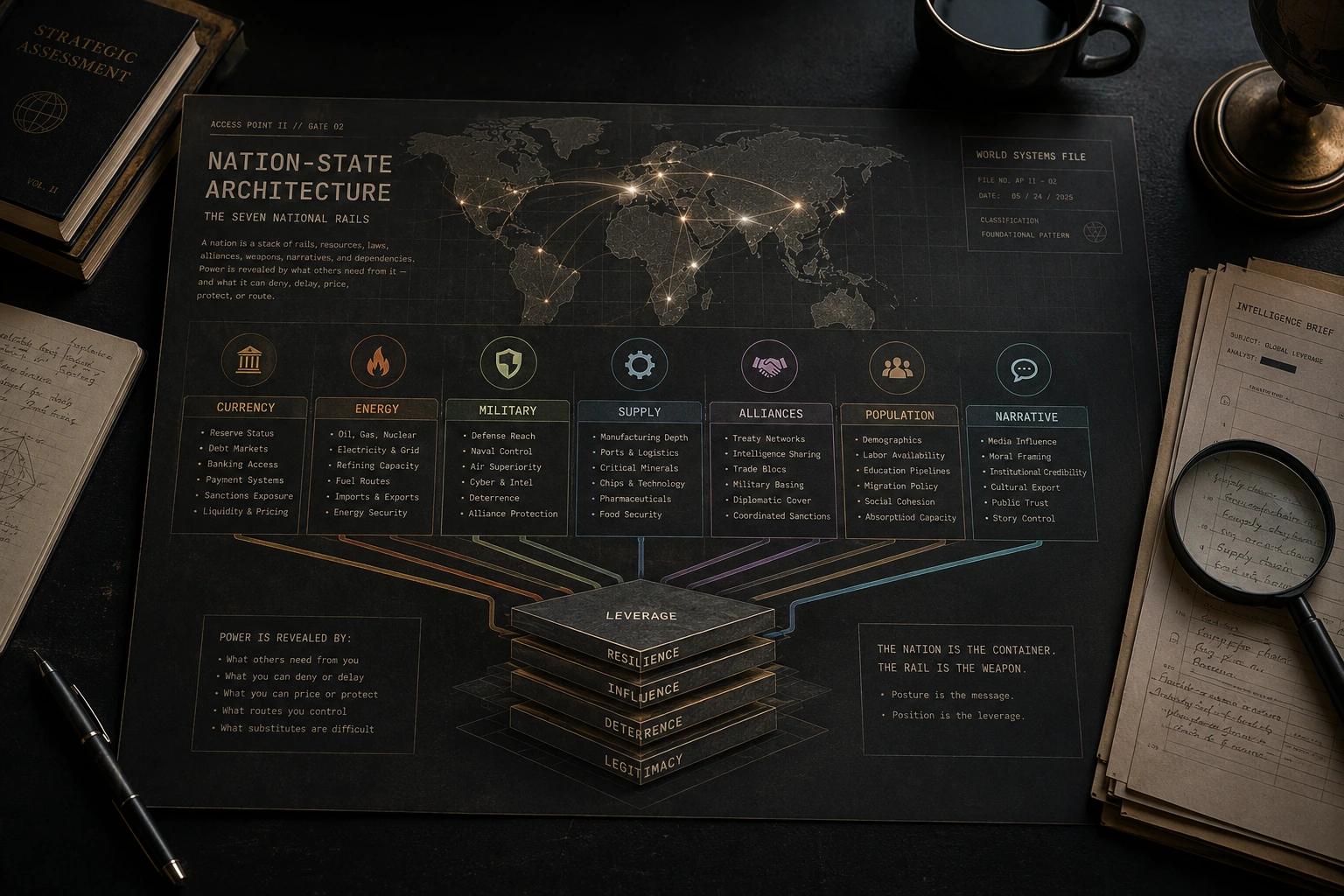
A nation’s leverage is revealed by what others need from it — and what it can deny, delay, price, protect, or route.
This is why two countries can look equal in speeches but completely unequal in structure.
One may have land, but no currency power.
One may have population, but no energy independence.
One may have resources, but no military shield.
One may have technology, but rely on another country’s minerals, chips, shipping lanes, or legal permissions.
The flag is the symbol. The rails are the structure.
The seven national rails
A nation-state architecture map begins by identifying which rails a country controls, which rails it depends on, and which rails can be used against it.
Currency: reserve currency, debt markets, banking access, sanctions exposure, payment systems, liquidity, and the ability to price global transactions.
Energy: oil, gas, nuclear, electricity, grid resilience, refining, fuel routes, imports, and the ability to keep industry functioning.
Military: defense reach, deterrence, naval control, air superiority, cyber tools, intelligence networks, and alliance protection.
Supply: manufacturing depth, ports, logistics, rare earths, chips, food supply, pharmaceuticals, industrial inputs, and substitution capacity.
Alliances: treaty networks, intelligence sharing, trade blocs, military basing, diplomatic cover, regional partnerships, and coordinated sanctions.
Population: birth rates, migration policy, labor availability, education pipelines, social cohesion, demographic pressure, and internal absorption capacity.
Narrative: media influence, moral framing, institutional credibility, cultural export, education systems, public trust, and the story a country tells about itself.
The strongest country is not always the loudest. It is the one with the most critical rails others cannot easily bypass.
National power is stacked, not singular.
A country may have military strength but weak manufacturing depth.
Another may have manufacturing depth but weak currency power.
Another may have resources but poor legal stability.
Another may have population scale but fragile social cohesion.
The mistake is asking, “Which country is powerful?” as if power is one object.
Which rail does this country control?
And where is it dependent?
Total leverage comes from the combined stack of currency, military, alliances, technology, energy, institutions, and market depth.
Chokepoint leverage comes from the ability to control one narrow route others need: chips, minerals, ports, shipping lanes, or industrial inputs.
Disruption leverage comes from the power to disturb markets, supply chains, energy flows, security arrangements, or narratives even without full dominance.
Legitimacy leverage comes from the power to make actions appear lawful, moral, necessary, inevitable, or globally acceptable.
The country is the container. The rail is the weapon.
When a nation controls a currency rail, it can influence debt, sanctions, reserves, trade settlement, and financial access.
When a nation controls an energy rail, it can shape price, industry, heating, transportation, military readiness, and public stability.
When a nation controls a manufacturing rail, it can shape availability, timing, inflation, substitution pressure, and crisis response.
When a nation controls a military rail, it can protect trade routes, deter enemies, secure allies, and turn geography into policy.
When a nation controls a narrative rail, it can define what the public calls peace, threat, compassion, progress, extremism, democracy, safety, or moral duty.
The speech tells you what a country wants you to see. The rail tells you what it can actually do.
That is why every national read must separate public posture from structural position.
Posture is the message.
Position is the leverage.
The Nation-State Map Drill
When a country enters the headline, do not start with the speech. Run the architecture.
01. What rail does this country control?
02. What is this country dependent on?
03. Where can it be pressured?
04. What can it deny or delay?
05. What substitute is being built?
Look for currency, energy, military reach, shipping, manufacturing, chips, food, minerals, payment access, law, narrative, or alliance protection.
Look for energy imports, foreign capital, outside technology, maritime routes, labor inflow, food supply, chip access, military protection, or public legitimacy.
Look for sanctions exposure, fragile demographics, social unrest, supply dependence, debt weakness, resource scarcity, chokepoint geography, or alliance strain.
The power to restrict access, slow supply, raise costs, withhold protection, block routes, shape narratives, or delay approvals reveals leverage.
Watch for reshoring, alternative currencies, new energy routes, parallel payment systems, domestic production, new alliances, and local supply chains.
Study countries to understand dependency, not to worship power.
Access Point II is not here to turn nations into idols.
It is here to reveal how earthly power organizes itself so you can stop being hypnotized by surface language.
A country can speak of freedom while building dependency.
A country can speak of compassion while importing labor leverage.
A country can speak of security while expanding surveillance.
A country can speak of peace while positioning for control of future rails.
Clear sight does not deny earthly systems. It refuses to be discipled by them.
The point is not fear.
The point is discernment.
Once you see how nations move through rails, you can make cleaner decisions around attention, money, location, publishing, technology, assets, and dependence.
You do not have to absorb every geopolitical frame as truth.
You can read the structure beneath it.