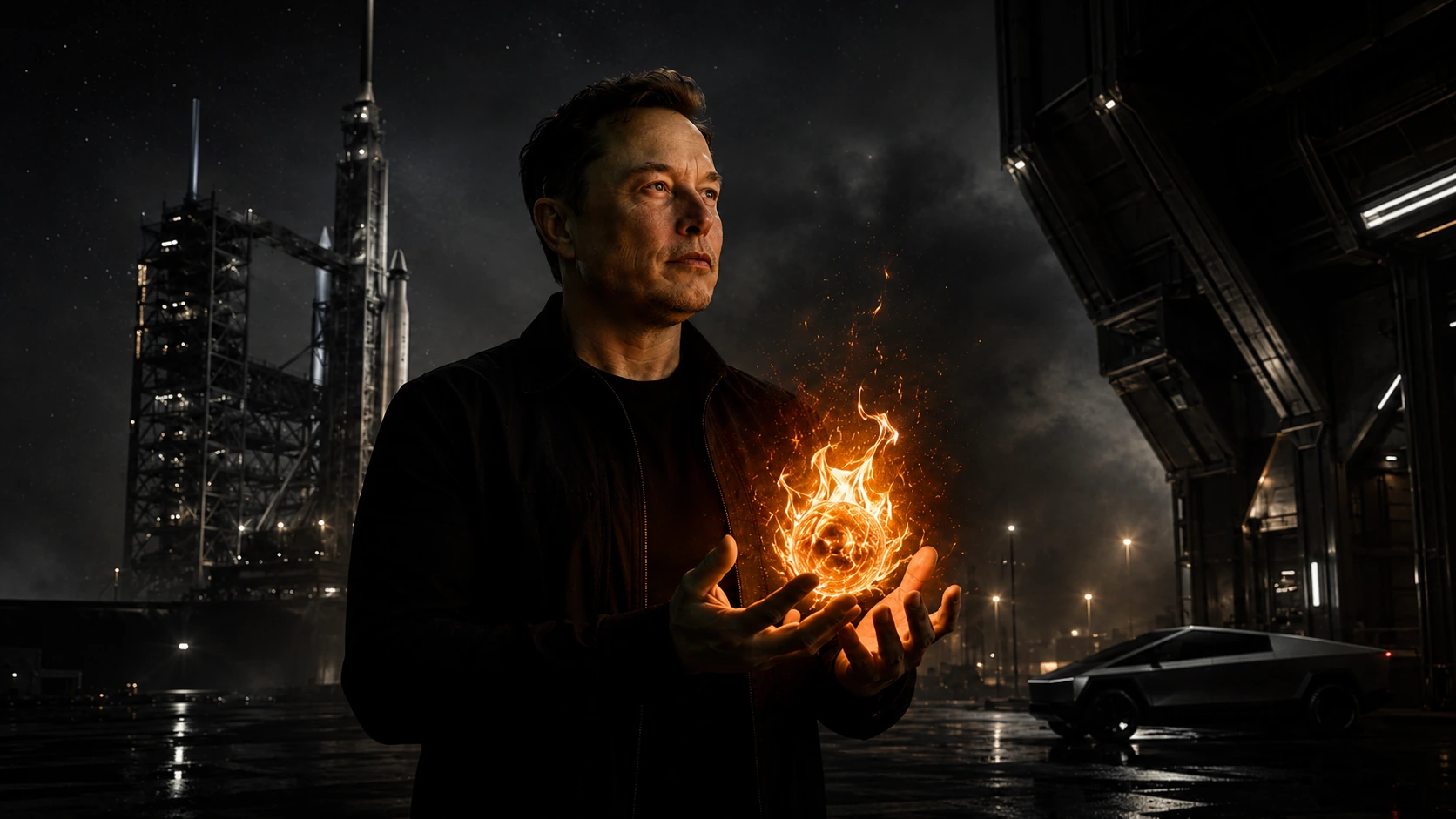
There is a strange thing that happens when a person carries too much future.
At first, people call it vision. Then they call it genius. Then they call it dangerous. Then, if the person keeps going, the culture stops knowing whether it is watching a builder, a warning, a prophet, a salesman, or a man slowly being consumed by the fire he brought down.
That is the real tension around Elon Musk.
Not whether people like him. Not whether people hate him. Not whether he is brilliant, reckless, misunderstood, arrogant, necessary, childish, prophetic, or dangerous.
Those arguments are too small now.
The deeper question is what happens when one person becomes a symbolic container for too much technological fire at once.
The Fire-Bearer Problem
When a figure brings multiple forms of technological power into public life at once, the culture begins reacting not only to the person, but to the fire itself. The argument becomes symbolic before people admit it has become symbolic.
Electric cars. Reusable rockets. Satellite networks. Artificial intelligence. Humanoid robots. Brain-computer interfaces. Mars. Free speech platforms. Autonomous systems.
The list starts to feel less like a business portfolio and more like a myth trying to update itself in real time.
People are usually not only reacting to the man. They are reacting to the fire.
The myth still knows what the culture forgets.
Prometheus is remembered as the one who stole fire from the gods and gave it to humanity. In the simplest version, fire means technology, knowledge, civilization, and the human ability to live beyond the limits nature originally gave us.
But the myth is not only a celebration of progress.
It is also a warning about stolen power.
Fire does not arrive as a neutral object. It arrives with consequence.
Fire warms. Fire destroys. Fire cooks food. Fire burns cities. Fire gathers people around it. Fire exposes what was hidden in the dark. Fire gives civilization its tools. Fire also gives civilization its weapons.
That is the Promethean problem.
Something is taken from above and brought into human hands before humanity has fully learned what kind of hands it has.
This is why Elon Musk is hard to discuss cleanly.
People want the fire and fear the fire at the same time.
We want the electric car.
We want the reusable rocket.
We want the satellite internet.
We want the robot that can do dangerous labor.
We want the brain interface that might restore autonomy.
We want the AI that can solve hard problems.
We want the future to arrive.
But we also want the fire to arrive without danger.
We want power without distortion. Invention without ego. Speed without collateral damage. Genius without instability. Technological acceleration without spiritual consequence.
That is not how fire works.
Fire always asks what kind of people are holding it.
The future is not only a technical problem.
This may be the deepest reason Elon makes people uncomfortable. He forces the culture to look at its own appetite.
It is easy to mock the ambition. It is easy to condemn the spectacle. It is easy to call him reckless. Sometimes that criticism may even be fair.
But the culture is not innocent in the exchange.
We reward the acceleration. We buy the products. We watch the launches. We refresh the feeds. We turn founders into mythic figures and then act shocked when they begin to behave as if the myth belongs to them.
A civilization that worships disruption should not be surprised when disruptors stop asking for permission.
That is the bargain.
The problem begins when the fire-bearer forgets that fire is not the same as wisdom.
A person can imagine the machine and still underestimate the human consequences of the machine.
A person can solve the engineering problem and still fail the authority problem.
A person can bring down fire and still lack the humility required to distribute it cleanly.
That distinction matters.
Because the future is not only a technical problem. It is a formation problem.
What kind of humans are being formed by these tools?
What kind of attention is being rewarded?
What kind of dependency is being created?
What kind of authority is being centralized?
What kind of world becomes impossible once this one is built?
Those questions do not fit neatly into a product demo. They do not move as fast as capital. They do not trend as easily as spectacle.
But they are the questions that decide whether fire becomes civilization or judgment.
The fire is bigger than the fire-bearer.
This is why the public argument around Elon Musk often feels strangely unsatisfying.
The fan says, “Look what he built.”
The critic says, “Look how he behaves.”
Both are looking at something real.
But neither is enough.
The deeper question is what kind of world this fire creates once it leaves the hands of the fire-bearer.
Because eventually, every Promethean figure becomes less important than the fire itself.
The rocket leaves the pad. The car drives without the driver. The model answers without the builder in the room. The implant transmits. The satellite network surrounds the planet. The robot enters the workplace.
At that point, the question is no longer only about Elon.
It is about us.
Can we receive power without worshiping the person who brought it?
Can we critique the fire without pretending we do not want its warmth?
Can we build institutions wise enough to govern what individuals are powerful enough to create?
Can we tell the difference between progress and possession?
Can we admit that some gifts arrive before the soul is ready?
That is the ancient question hiding inside the modern one.
Elon Musk is not the fire.
He is one of the most visible fire-bearers of our age.
The fire is bigger than him. The danger is bigger than him. The possibility is bigger than him.
The question is not whether we should worship him or destroy him.
The question is whether we can become the kind of people who know what to do with the fire once it is in our hands.
Because the future does not only need builders.
It needs discernment.
And fire without discernment does not stay a gift for long.